
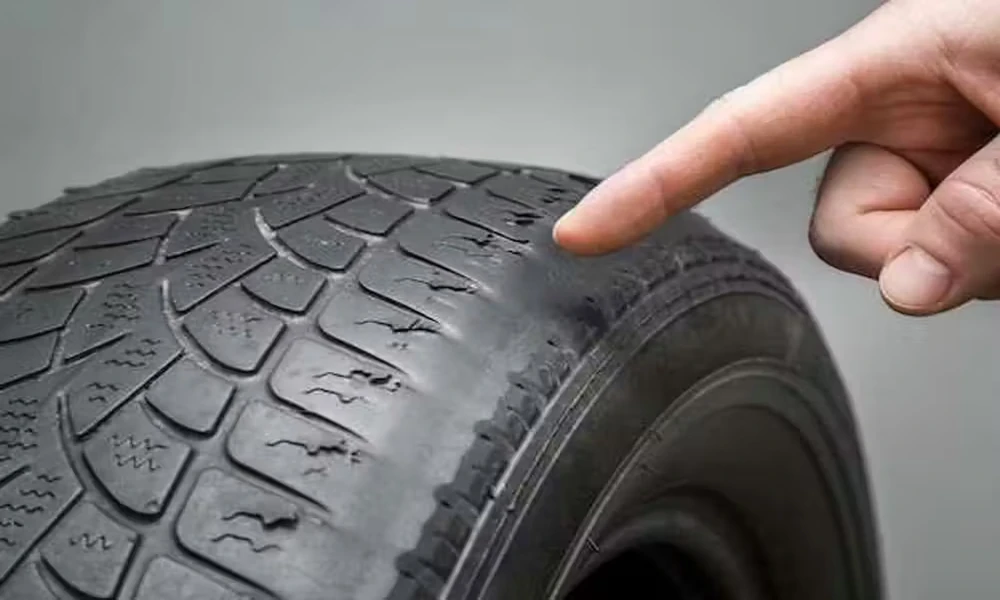

Almost every trailer tire that comes apart on the shoulder of I-15 still has usable tread on it. Trailer tires rarely wear out the way truck tires do, because most trailers cover far fewer miles than the vehicle pulling them. They age out instead, and heat, sunlight, and underinflation do the work long before the tread blocks disappear. Anyone buying from Workhorse Trailers or shopping a used trailer should learn to read a sidewall before trusting what the tread depth suggests.
How do you find out how old your tires actually are?
Look for the DOT code molded into the sidewall and read the last four digits. Those numbers give the week and year of manufacture, so a code ending in 2724 means the tire was built in the 27th week of 2024.
Two things surprise people. The full DOT code often appears on only one sidewall, so you may have to crawl under and look at the inboard side. And a new trailer does not necessarily have new tires, since tires can sit in a warehouse for a year or more before they are mounted. Checking the date code at delivery takes thirty seconds and tells you where you actually stand.
How long do trailer tires last?
By age rather than mileage. Many trailer tire manufacturers recommend replacement somewhere in the range of three to five years of service regardless of remaining tread, and NHTSA has advised consumers to follow vehicle and tire manufacturer guidance on age-based replacement, with six years frequently cited as the point to start paying close attention and ten years as an outer limit for any tire.
Check the specific recommendation from whoever made your tires, since it varies. The general principle holds across brands: a trailer tire with plenty of tread and a date code from seven years ago is not a tire anyone should be loading a skid steer onto.
Why does Utah shorten their life?
Sunlight and heat, in a combination this state produces well. Ultraviolet exposure and ozone break down rubber compounds over time, and elevation along the Wasatch Front means stronger UV than at sea level. Trailers typically sit outside between jobs, often in the same orientation, which is why the sun-facing sidewall usually cracks first.
Summer pavement temperature runs well above air temperature, and a loaded tire flexing at highway speed generates its own heat on top of that. Look for fine cracking in the sidewall and between tread blocks, which is often called weather checking. It signals the rubber is deteriorating no matter what the tread gauge says.
Parking on gravel or dirt rather than hot asphalt, and covering tires during long storage, both help. So does not letting a trailer sit in one position for six months.
What is the difference between ST and LT tires?
ST stands for Special Trailer, and those tires are built for a different job than the ones on your truck. They use stiffer sidewalls to resist sway and are designed to carry load rather than to steer or drive.
LT means light truck. LT tires can be used on some trailers, but the load calculation changes and the handling characteristics differ, so this is a decision to make deliberately with someone who knows the application rather than by grabbing whatever is on sale.
Traditional ST tires also carry speed limitations. Many are rated for a maximum of 65 miles per hour, with some newer ones carrying a speed symbol permitting more. Running above the rated speed builds heat and can reduce the tire’s effective capacity. Anyone cruising 80 on the interstate should confirm what their specific tires are rated for.
What pressure should trailer tires run?
The maximum cold inflation pressure printed on the sidewall, in most trailer applications, checked before the trailer has been driven.
Cold means genuinely cold, not after ten miles. Pressure rises as the tire heats, and that increase is normal and expected. Bleeding air out of a hot tire to bring the number down leaves it underinflated once it cools, which is the exact condition that causes the sidewall flexing and heat buildup behind most blowouts.
Check all of them, including the spare, before any long haul. A tire losing a few pounds over a month is telling you something.
Are your tires rated for what you are hauling?
Add up the tire capacities per axle and compare that to the axle rating. A 7,000-pound axle needs tires rated at roughly 3,500 pounds each at their specified pressure to match it, and the number on the sidewall applies only at the stated inflation.
Load range letters indicate construction and capacity, with C, D, and E common on equipment trailers and E carrying the most. Two trailers with identical deck dimensions can have very different capability depending on what is mounted under them, which is worth asking about when comparing quotes.
What else fails on the same schedule?
Wheel bearings, and they take tires with them. Repacking bearings annually or at intervals commonly cited around 12,000 miles is standard maintenance that plenty of owners skip until a hub starts smoking on a grade.
Lug nuts need attention too. After any wheel is removed and reinstalled, re-torque the lugs to the manufacturer’s specification after the first several miles and again shortly after, because they settle. Carry a spare, a jack rated for the load, and the correct lug wrench, since roadside help for trailers is thin on rural Utah highways.
What Workhorse Trailers buyers should check before the first haul
Read the date codes on all tires including the spare, set cold pressure to spec, confirm the tire capacity matches the axle rating for the loads you plan to carry, and ask what the tires are rated for at highway speed.
Ask about tire and axle specifications during the build conversation rather than after delivery, since upgrading load range at order time costs far less than replacing a set later. Talking through your actual hauling weights with Workhorse Trailers gets the right rubber under the trailer from the start, which is the cheapest blowout prevention available.